
Reviewed · BUKCHON AND INSADONG WALKS
Best Walking Tour to Gyeongbok Palace Bukchon Hanok Village
Gyeongbokgung Palace and Bukchon Hanok Village give you two very different views of Seoul in one outing: the grand seat of royal power and a hilly neighborhood of traditional homes. The changing of the guard, palace courtyards, National Folk Museum, and old-style lanes make this a strong first look at Korea’s capital.
I like the small group of no more than eight and the way the tour links architecture with daily life. I also like the knowledgeable, warm guides, including Jay Kim, Stella, Jack, Paul, and Joe, who have been praised for clear English, personal stories, and thoughtful help with photos and food suggestions. The main drawback is guide consistency. A few people found their guide low-energy or vague, so the quality of your three hours can depend heavily on who leads it.
Key points to know before booking
- The guard-changing ceremony adds movement and color to the palace visit, rather than leaving you with courtyards alone.
- Gyeongbokgung receives about an hour, with admission included and time for palace buildings, history, and traditional construction details.
- Bukchon takes you uphill, with roughly 30 minutes in the village and additional walking between major stops.
- The National Folk Museum adds everyday context, with more than 98,000 artifacts about Korean life and history.
- The tour ends near Insadong, a useful spot for continuing your Seoul sightseeing or finding a meal.
- The $88 price is easiest to justify for first-time visitors who want a guide, entrance fee, and compact introduction in one booking.
Why this is a useful first morning in Seoul
Seoul can feel enormous at first. Modern towers, busy roads, royal gates, quiet alleys, and old homes all sit close together, but the connections are not always obvious when you explore alone.
This walk gives you a basic map of the city’s past. You begin near central Seoul, see the King Sejong statue, move through Gwanghwamun Gate and Gyeongbokgung Palace, then walk toward Bukchon and finish in Insadong. The route connects royal government, traditional housing, language, folk customs, and present-day city life.
I especially like this arrangement for your first full day. You get enough background to make later visits to palaces, markets, museums, and neighborhoods easier to understand. The tour is not just a series of photo stops. At its best, it explains how the Joseon Dynasty shaped the city and how older traditions still appear in modern Seoul.
The group limit matters here. Eight people is small enough for questions and conversation, but it does not guarantee a private tour. Several bookings have ended up with only one or two people, which can turn the outing into a personal walk. That depends on the date and demand.
More Bukchon and Insadong walks:
- Seoul: Gyeongbok Palace, Bukchon Village, and Gwangjang Tour
★ 4.9 · 2,321 reviews - Best Seoul City Tour (Gyeongbokgung Palace,Insadong,Namsan Tower)
★ 5.0 · 1,647 reviews - Seoul: Gyeongbok Palace, Bukchon Village, and Gwangjang Tour
★ 5.0 · 1,044 reviews
Meeting the royal city at Gwanghwamun
The walk begins at 24-1 Taepyeongno 2(i)-ga in Jung District. The route then brings you toward the King Sejong statue and Gwanghwamun Gate, the impressive front entrance to Gyeongbokgung.
The King Sejong stop gives the guide a natural chance to explain one of Korea’s most important rulers. This is also where the tour’s past-and-present theme begins. You are in central Seoul, surrounded by a modern capital, yet the route points directly toward a royal complex built for a very different city.
Your guide should help you understand what you are looking at before you enter the palace. That early explanation is valuable because Gyeongbokgung is large and can seem like a long sequence of gates, courtyards, wooden halls, and rooflines without context.
The exact meeting point deserves attention. You receive confirmation when booking, and you should allow time to reach the start using Seoul’s public transportation. The tour is near transit, but the information provided does not identify a particular subway exit or station, so check the mobile ticket carefully before setting out.
Gyeongbokgung Palace and the guard change
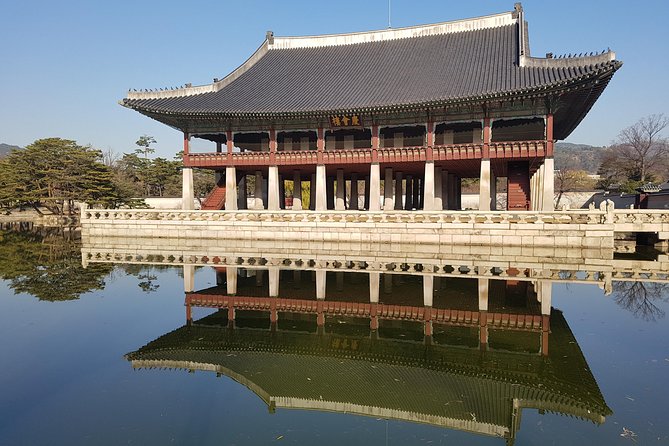
Gyeongbokgung is the main event. Built as the principal palace of the Joseon Dynasty, it gives you a look at royal architecture, ceremony, and court planning in one place.
The scheduled palace portion lasts about an hour, including admission. That is enough time for a focused introduction, but not enough for every corner of the grounds. You should expect an edited visit rather than a full day at the palace.
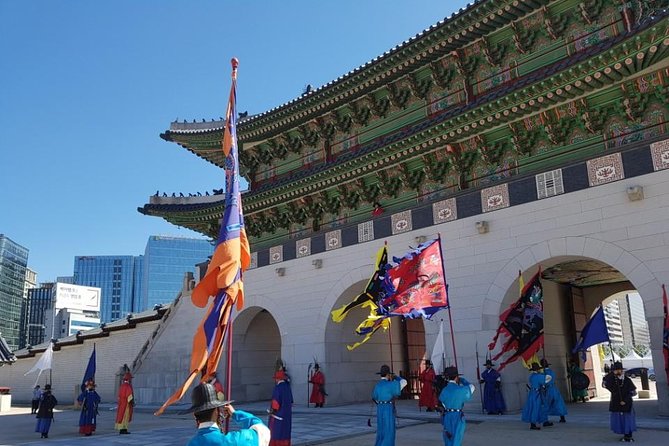
The royal guard-changing ceremony adds a welcome burst of action. Bright uniforms, formal movement, and the ritual of the change give you a sense of how the palace functioned as a working royal center. Your guide can explain what the ceremony represents and point out details that are easy to miss when you are watching the spectacle.
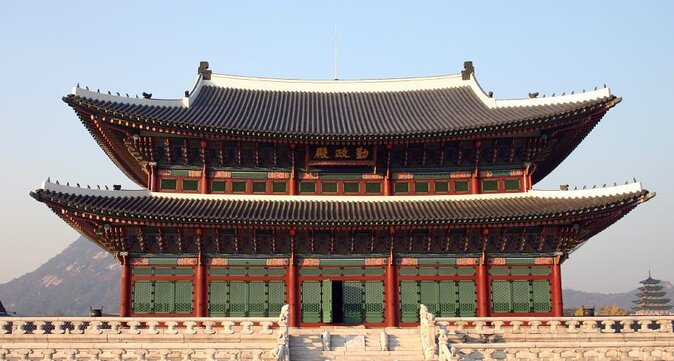
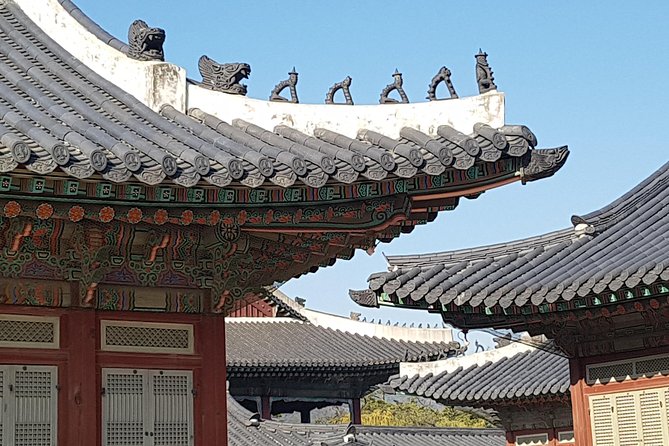
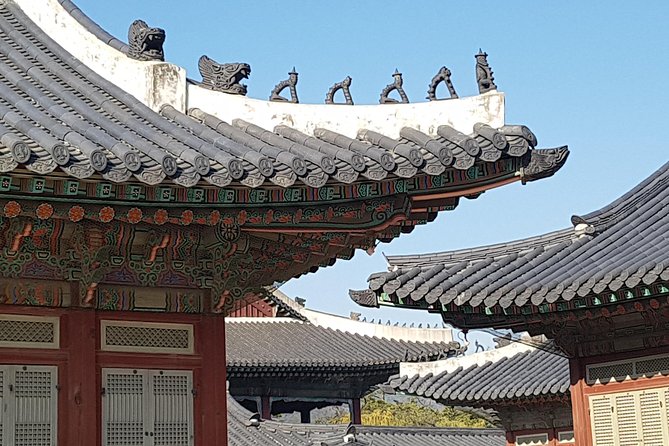
Inside, the focus turns to traditional construction. Look at the raised foundations, painted wooden beams, tiled roofs, and careful spacing of the buildings. A good guide makes these details easier to read. Jay Kim, Stella, Jack, Paul, and Joe have each been praised for explaining palace design alongside Korean history and culture, though the experience varies by guide.
The best accounts of the tour describe guides who connect palace events to Korea’s wider story. Joe, for example, has been praised for linking the palace to Korea’s development from its earliest periods through modern times. Jay Kim is noted for answering questions and explaining both Seoul and the palace in clear English. Stella has been singled out for keeping the material lively enough for families and younger visitors.
That range matters. A palace tour succeeds when the guide does more than name buildings. You want to hear why the palace was arranged as it was, how people lived within the royal system, and what later events did to the country. The tour promises this kind of context, but your guide’s energy and preparation will shape how much you receive.
The National Folk Museum and daily Korean life
The National Folk Museum of Korea adds a different layer to the palace visit. Instead of focusing only on kings, ceremonies, and grand buildings, it presents more than 98,000 artifacts connected with South Korea’s history and everyday customs.
This is one of the most useful parts of the route because it shifts your attention from the court to ordinary life. Palace architecture can tell you how rulers wanted the world arranged. Folk objects help show how people worked, dressed, worshipped, celebrated, and managed daily routines.
The museum visit also helps prevent the palace from feeling frozen in a distant era. Korea’s past was not only made by monarchs. It was also shaped by households, craftspeople, farmers, teachers, and families. If you are new to Korean history, this stop can give you a clearer sense of how society worked beyond the palace walls.
The supplied schedule does not assign a separate time for the museum, so the guide may need to keep this portion concise within the three-hour limit. If museum collections are a major priority for you, plan to return on your own rather than expecting a long independent visit during the tour.
More Hanok Village Tours in Seoul:
- Seoul City Sightseeing Tour Including Gyeongbokgung Palace, N Seoul Tower, and Namsangol Hanok Village
★ 5.0 · 1,423 reviews - Seoul: Gyeongbok Palace and Bukchon Hanok Walking Tour
★ 4.8 · 157 reviews - Experience Korean Cooking in Modern Hanok Kitchen
★ 5.0 · 118 reviews - Seoul: Perfume-Making Workshop in a Hanok
★ 4.9 · 110 reviews
Walking from royal grounds to Bukchon
The transition from Gyeongbokgung to Bukchon Hanok Village is one of the route’s strongest ideas. You are not simply transported between attractions. You walk through the central city and watch the setting change from palace grounds to residential lanes.
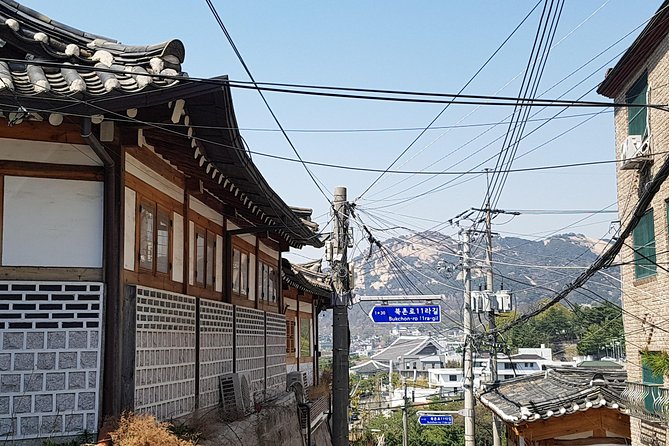
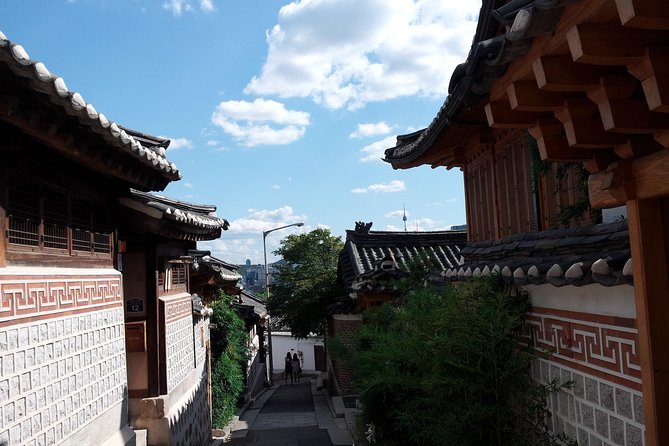
Bukchon is known for its traditional hanok homes, with tiled roofs, wooden details, and tightly packed streets that climb between Gyeongbokgung and Changdeokgung. The tour includes about 30 minutes in the village, described as a chance to look into traditional homes and learn about Korean lifestyles from earlier times to the present.
Do not expect a flat stroll. Bukchon includes uphill sections and steps, and the route can be tiring in warm weather or rain. Comfortable shoes are essential. Anyone with trouble walking on steps or uphill paths should choose a different activity or ask the operator for more detail before booking.
The short scheduled time in Bukchon is enough for an introduction and photographs, but it will not cover every lane. The village is also a lived-in neighborhood, so your guide’s direction is useful. You can learn how the houses were used and see how older residential design fits into present-day Seoul.
This is where the tour feels most connected to ordinary life. The palace shows the official face of the Joseon world. Bukchon gives you a closer look at homes and neighborhoods. That contrast helps you understand that Korean tradition is not limited to royal costumes and grand gates.
Finishing in Insadong
The tour ends at 75-5 Insa-dong in Jongno District, near the Insadong area. This is a practical finish because you can continue exploring after the guide leaves.
Insadong is a good place to extend the day with food, shops, galleries, and nearby historic streets. The tour itself does not include lunch, but several guides have offered restaurant recommendations, and one guide was praised for ending the outing with advice about typical Korean dishes. Treat those suggestions as a helpful extra, not a guaranteed part of the booking.
Some guides have also gone beyond the core route when time and weather allowed. One guide drove participants to additional places during rain, while others stopped for street food, helped with photos, or showed visitors a shopping area they wanted to see. These personal touches can make a small tour memorable, but they are not promised inclusions.
The finish near Insadong also means you are not left at the palace with a long return trip. You can eat nearby, explore more on foot, or use public transportation to reach another part of Seoul.
What the $88 price really buys
At $88 per person, this is not the cheapest way to see Gyeongbokgung and Bukchon. You can visit the areas independently for less, especially if you are comfortable reading maps, researching Korean history, and organizing the route yourself.
The price becomes easier to defend if you value a compact, guided introduction. It includes the professional guide and palace admission, and the group is capped at eight. You are paying for interpretation, route planning, and the chance to ask questions while moving through several major sights.
For a first visit, that can be good value. A strong guide may explain the difference between palace spaces, connect the buildings to Korean history, describe traditional construction, and help you understand what you see in the museum and village. You also avoid spending your limited Seoul time deciding where to go next.
The weak point is not the route but the human factor. Several guides have earned warm praise for clear English, strong historical explanations, and genuine pride in Korea. Jack has been praised for connecting one sight to the next and welcoming questions. Paul has been described as fluent, energetic, and willing to add street food or restaurant advice. Other feedback describes guides who rambled, relied too much on Google or YouTube, or offered only basic information.
Because the group may be very small, guide quality has an outsized effect. If your guide is excellent, $88 can feel fair. If the commentary is thin, the same price feels high for a walk you could have arranged yourself.
Timing, fitness, and weather
The advertised duration is about three hours. The main scheduled stops are roughly one hour at Gyeongbokgung and 30 minutes at Bukchon, with the remaining time used for the guard change, the museum, walking between sites, and surrounding sights.
Allow for a steady pace. This is not a gentle stroll with long café breaks. You will cover city streets, palace grounds, and uphill village lanes. Wear supportive shoes and clothing suited to the weather.
The experience requires good weather. If poor weather forces cancellation, you are offered another date or a full refund. A minimum number of participants also applies, so a cancellation is possible if that minimum is not reached. Changes or cancellations made less than 24 hours before the start time are not accepted, while cancellations at least 24 hours ahead receive a full refund.
The mobile ticket is convenient, but you still need to know the meeting address and arrive ready to walk. Confirmation comes at booking, and the activity is near public transportation.
Who will get the most from this walk
I would choose this tour if you are visiting Seoul for the first time and want historical context without committing to a full-day program. It also suits families, provided everyone can manage steps and hills. One guide kept a young visitor engaged with stories, while other guides made room for questions and photos.
It is a good match for anyone who likes history explained through places. The palace, museum, village, and Insadong finish create a useful introduction to Seoul’s older core.
You may want another option if you prefer to explore slowly, spend hours inside museums, or avoid group tours altogether. The schedule is compact, and Bukchon’s short visit will not satisfy someone hoping to wander every alley. You should also think twice if uphill walking is difficult.
FAQ
How long does the Gyeongbokgung and Bukchon tour last?
The tour lasts approximately three hours. About one hour is allocated to Gyeongbokgung Palace and about 30 minutes to Bukchon Hanok Village, with the rest used for walking, the guard ceremony, the museum, and other route stops.
What is included in the price?
The professional guide and palace admission fee are included. The tour also provides a mobile ticket.
Where does the tour start and finish?
It starts at 24-1 Taepyeongno 2(i)-ga in Jung District, Seoul. It finishes at 75-5 Insa-dong in Jongno District, in the Insadong area.
How large is the group?
The activity has a maximum of eight participants. Depending on the date, the group may be smaller, and some departures have operated with only one participant.
Is the walk suitable for people with limited mobility?
The tour requires a moderate level of fitness and is not recommended for people who have difficulty with steps or uphill walking. Bukchon Hanok Village includes uphill sections.
Can I cancel for a full refund?
Yes. You can cancel at least 24 hours before the experience start time for a full refund. Cancellations or changes made less than 24 hours before the start time are not accepted, and poor-weather or minimum-participant cancellations offer either another date or a full refund.
Should you book it?
Book this walk if you want a focused introduction to Seoul’s royal and traditional sides and prefer a guide to explain the meaning behind the buildings. The route is well chosen, the palace admission is included, and the small group can make the experience personal.
I would book it early, since it is often reserved about 30 days ahead, and I would begin with realistic expectations. You are buying three hours of guided history and walking, not a leisurely full-day palace visit. Wear good shoes, prepare for hills, and understand that the guide assigned to your date matters greatly.
For a first day in Seoul, this is a sensible choice. For repeat visitors or independent explorers, the price may be better spent on separate admissions and a slower self-guided afternoon.
More Walking Tours in Seoul
- Seoul moonlight walking tour with local historian
★ 5.0 · 940 reviews - Seoul: Nighttime Hidden Gems Walking Tour
★ 5.0 · 775 reviews - Seoul: Evening Dark History, Folklore & Ghost Story Walking Tour
★ 5.0 · 593 reviews - Seoul: Dark Side of the City and Ghost Stories Walking Tour
★ 4.8 · 484 reviews
Recently added around Seoul
- Gyeongbokgung Palace Photo Session with your own phone★ 5.0 · 4 reviews
- Private Tour around Suwon UNESCO Fortress and Korea Folks Village★ 4.5 · 4 reviews
- Nami & Maple Road & Theatre des Lumieres Day Tour from Seoul★ 4.8 · 4 reviews
- Seoul: Deoksugung Palace Night Tour★ 4.5 · 4 reviews
- N Seoul Tower + Namsan Cable Car Ticket (Collect in Myeongdong)★ 3.5 · 4 reviews
- Jisan Forest Resort: Ski Full-Day Tour or Shuttle from Seoul★ 5.0 · 4 reviews
- Private Jeonju Hanok Village – Culinary tour★ 5.0 · 4 reviews
- Seoul Private Walking Tour with a Local★ 5.0 · 4 reviews
Bukchon and Insadong Walks, compared.
Gyeongbok Palace, Bukchon Village, and Gwangjang Tour
Read the review →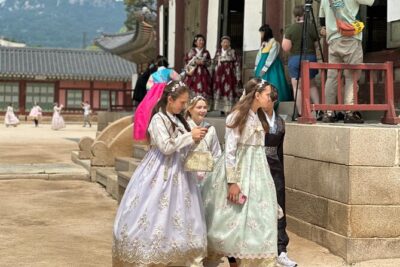
Best Seoul City Tour (Gyeongbokgung Palace,Insadong,Namsan Tower)
Read the review →Gyeongbok Palace, Bukchon Village, and Gwangjang Tour
Read the review →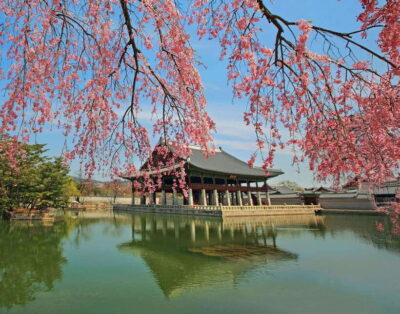
Seoul Highlights: Gyeongbok Palace, Insadong & N Seoul Tower
Read the review →
Korean Palace and Market Tour in Seoul Including Insadong and Gyeongbokgung Palace
Read the review →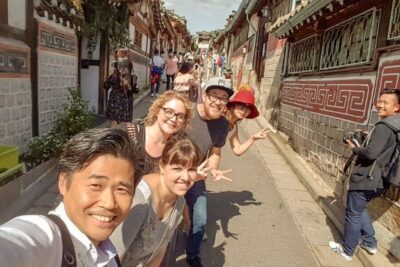
Gyeongbok Palace and Bukchon Hanok Walking Tour
Read the review →
Carve Your Personal Korean Stone Seal with Jeongju in Insadong
Read the review →
Write a Meaningful Korean Calligraphy Scroll in Insadong
Read the review →Browse the lists this tour appears in