
Reviewed · SEOUL TOURS
Seoul History Walking Tour
Seoul’s story comes into focus on this walk, which links Joseon kings, Japanese occupation, and democracy in one compact route. You begin at the Bosingak Bell Pavilion and finish near Jogyesa Temple, passing monuments, civic spaces, a former foreign legation, and the site of a long-running protest. I like the clear historical arc, and I like the small maximum group of eight, which gives you a better chance to ask questions. The tour also includes traditional Korean snacks and a printed memento.
The main consideration is pace. You cover 15 stops in about three and a half hours, with several 10-minute visits. This is best for you if you enjoy listening while walking and can stay on your feet. It is less suited to anyone hoping for long museum visits or much free time at each site.
Key points before you book
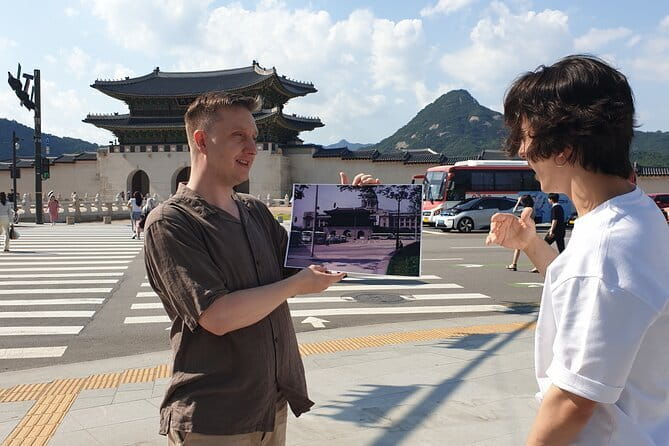
- A 630-year history lesson in one walk: The route moves from the Joseon Dynasty through imperial rule, war, dictatorship, and modern democracy.
- A genuinely small group: The tour accepts no more than eight people, a useful advantage for questions and conversation.
- Strong civic and political focus: Gwanghwamun Square, the Japanese Embassy, and Seoul Plaza show how public space shaped Korea’s modern story.
- Free sights keep the price sensible: At $26.60, you are paying mainly for the guide, route, interpretation, snacks, and compact format rather than entrance fees.
- A central start and finish: Bosingak and Jogyesa Temple are both in central Seoul, and the tour ends up the street from its starting area.
- An afternoon schedule: The walk begins at 2:30 pm, leaving your morning open for another part of Seoul.
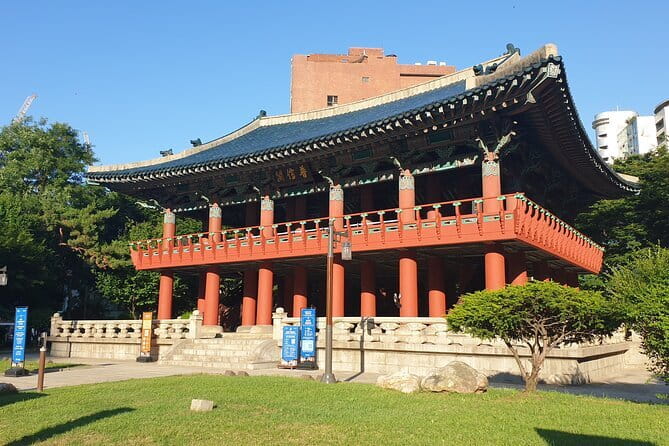
Seoul’s story begins at the Bosingak bell
Meet at Bosingak Bell Pavilion on Jong-ro at 2:30 pm. The first stop is brief, but it sets the tone. You learn why the city bell rang 28 times at night and 33 times in the morning, a small detail that turns an ordinary monument into a doorway to old Seoul.
From here, the route heads toward Cheonggyecheon Stream. You spend about 40 minutes here, the longest stop on the walk. That extra time matters because the stream is not just a pleasant urban waterway. Your guide explains what it meant during the Joseon period, how it figured into life during the Korean War, and what role it plays in modern Seoul.
I like this early section because it shows how one place can carry several layers of city life. You are not simply hearing about a royal court, then jumping to a modern skyscraper. You are following a physical feature through changing periods of Korean history.
More Historical Tours in Seoul
- Seoul: Evening Dark History, Folklore & Ghost Story Walking Tour
★ 5.0 · 593 reviews - Hanbok Photoshoot and History Tour at Gyeongbokgung Palace
★ 5.0 · 276 reviews - From Seoul: Dae Jang Geum Park Historic K-Drama Set Tour
★ 4.9 · 143 reviews
City Hall and Seoul Plaza show modern Seoul at work
The next stops shift from old civic life to the capital you see today. Seoul City Hall receives only about five minutes, but the guide points out why the building matters both inside and out. Seoul Plaza gets a little longer, with a focus on how the open space reflects the concerns and hopes of modern citizens.
This is a useful contrast with palace-centered sightseeing. At Seoul Plaza, history is not only about rulers and official buildings. It is also about public gatherings and the way ordinary people use the center of their capital.
The short timing can feel tight. You should expect an explanation rather than a full architectural visit. Still, the stops help you read Seoul’s central district with more purpose when you explore it on your own later.
Look across the palace district from Jeongdong Observatory
Jeongdong Observatory gives you a brief chance to look over the palace and city views. The stop lasts about 10 minutes, so this is a lookout and orientation point, not a long photography session.
I find views like this especially useful early in a Seoul visit. After walking through streets and civic squares, you get a sense of how the central districts fit together. The view also prepares you for the next group of stops, which deal with royal power, foreign influence, and Korea’s loss of independence.
The tour does not list an admission fee for any of its stops, and the observatory is included without a separate ticket charge. Bring your own water, though. Bottled water is not included.
Deoksugung’s stone wall carries a curious legend

Along Deoksugung Doldam-gil, the guide explains the Korean belief that couples who walk beside the palace wall will soon divorce. It is a memorable piece of folklore, and it gives the walk a lighter moment before the tour turns toward painful political history.
The stop lasts about 10 minutes. You should not expect a full tour of Deoksugung Palace itself. Instead, the wall and surrounding street provide a setting for a story about Korean tradition, romance, and the way local sayings survive in a modern city.
This is one reason I like the route’s structure. It does not treat history as a row of dates. It mixes a bell ritual, an urban stream, a divorce legend, political coercion, and democratic protest. The result feels closer to how a city is actually remembered.
A different way to spend a day from here:
- Best DMZ Tour Korea from Seoul (Red Suspension Bridge Optional)
★ 5.0 · 41,422 reviews - DMZ Tour: 3rd Tunnel, Option(Suspension Bridge, Boat) from Seoul
★ 5.0 · 21,373 reviews - DMZ tour south Korea from Seoul (NK experience hall, defector)
★ 5.0 · 20,599 reviews - Seoul: DMZ Tour with Optional Suspension Bridge
★ 4.8 · 5,277 reviews
Jungmyeongjeon Hall explains the loss of Korean independence
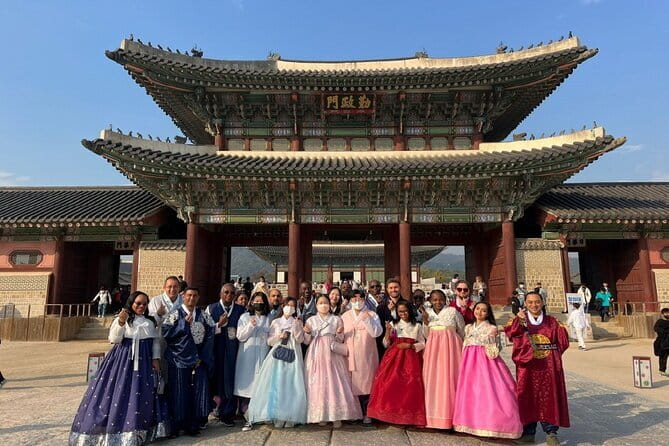
At Jungmyeongjeon Hall, the subject becomes much darker. You learn how Imperial Japan forced Korea to surrender its independence. The stop takes around 10 minutes, enough for a focused explanation of the political pressure and the damage done to Korean sovereignty.
This is a key point in the walk because it connects the palace district to the later national story. Korean history did not move in a simple line from royal dynasty to modern success. Foreign control, war, dictatorship, and public resistance all shaped the country you see now.
The stop may feel brief if you want detailed military or diplomatic history. The value here is the larger connection. Your guide is building a timeline you can carry into later visits to Seoul’s palaces and museums.
Ewha Museum brings women into the story
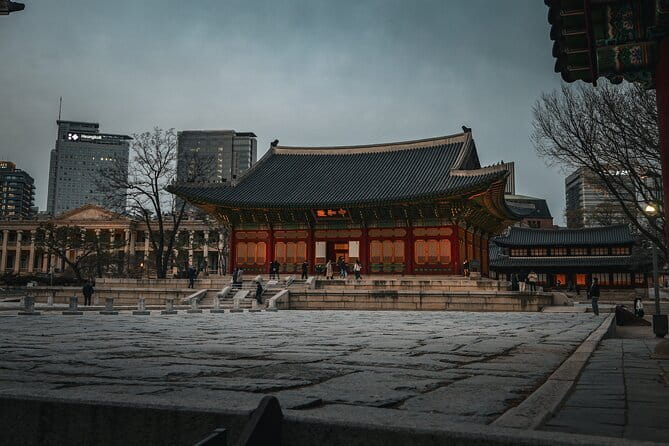
Ewha Museum introduces the first school for girls in Korea and asks how education changed views of women’s roles. The stop lasts about 10 minutes, but its subject expands the tour beyond kings, generals, and presidents.
I appreciate this inclusion. A city history walk can easily focus only on men in power. Here, education and changing social expectations become part of the story. You get a clearer sense of how Korean society changed from the Joseon period into the modern era.
Again, this is an outside-focused stop rather than a long museum visit. If you want to examine displays in detail, you would need to return separately. On the tour, the museum serves as a concise marker of social change.
The Former Russian Legation reveals a royal escape
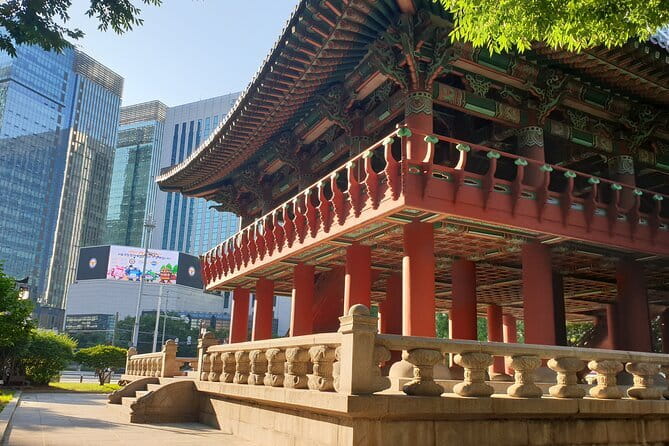
The Former Russian Legation is one of the route’s most intriguing stops. Your guide explains why Korea’s penultimate monarch fled his palace in the middle of the night and stayed here for a year. The stop lasts about 20 minutes, giving the story more room than most of the earlier sites.
That extra time is welcome. The building represents a moment when foreign powers pressed hard on Korea and the royal court sought protection beyond its own palace walls. It is a vivid example of how international pressure could reach directly into the life of a monarch.
For me, this is where the tour’s political history becomes personal. You are not only hearing that Korea was caught between larger powers. You are considering one ruler’s dramatic decision to leave his palace and remain in a foreign diplomatic setting.
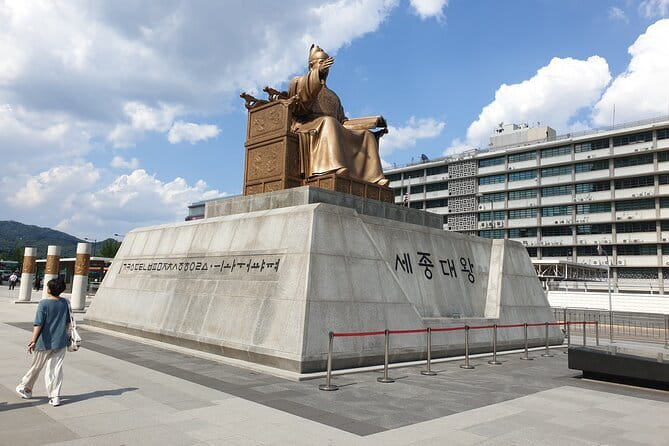
Admiral Yi and King Sejong anchor Gwanghwamun
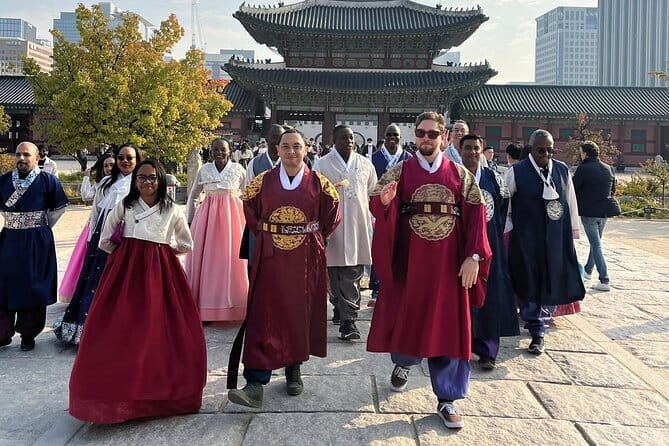
The route then reaches the statues of Admiral Yi Sun-sin and King Sejong the Great. Each receives about 10 minutes.
At Admiral Yi’s statue, the guide explains how this general helped save Korea and changed the course of world history. The phrasing is bold, but the stop gives you a chance to understand why Yi remains such a powerful national figure. His place in Gwanghwamun Square is not decorative. It reflects military memory and national pride.
The statue of Sejong the Great shifts the focus to culture and government. You learn why he is regarded as the greatest king of the Joseon Dynasty. This pairing works well: Yi represents defense in a national crisis, while Sejong represents leadership, learning, and public benefit.
If you are visiting Gyeongbokgung Palace or other royal sites later, these two stops will give you helpful context. The tour does not replace a palace visit, but it helps you understand the figures behind the names.
Gwanghwamun Square turns history into public action
Gwanghwamun Square receives 25 minutes, one of the longer stops on the route. The central question is direct: how many protests does it take to change a democracy?
This is the tour’s clearest look at South Korea’s struggle against dictatorship and its citizens’ fight for democratic government. The square is treated as a civic stage, not just a broad avenue with statues. Your guide connects the space to protest, political pressure, and modern public life.
I consider this one of the strongest parts of the experience. Many historic tours stop once they reach the modern period. This one keeps going, showing that Korea’s history is still being shaped in streets and squares.
The subject may be serious, and the short time means you will receive a compact account rather than a full political seminar. Still, it gives you a framework for understanding why public gatherings matter so much in Seoul.
The contemporary history museum gives you a rooftop view
At the National Museum of Korean Contemporary History, you spend about 15 minutes and look across Seoul from the rooftop. The stop connects the visual city around you with the modern story you have been hearing.
A rooftop view can sometimes feel like a pause between serious subjects, but here it has a clear purpose. You can look out over the city while considering how quickly Korea changed from monarchy and foreign domination to a modern global power.
The tour does not include a museum admission charge, and the stop is not presented as a full indoor museum visit. Think of it as a viewpoint and a final piece of orientation rather than a substitute for a separate museum visit.
The Japanese Embassy and Jogyesa Temple close the walk
Near the Japanese Embassy, the guide explains why the site is associated with the world’s longest-running protest. This is another stop that links Korean history to continuing public action. It also shows that difficult relations with Japan are not confined to textbooks or monuments.
The final stop is Jogyesa Temple, where the guide explains how the ringing of bells connects people with the universe. After the tour’s political subjects, the temple provides a calmer ending and a shift toward Buddhist ideas.
The walk ends directly up the street from where it began. That makes the return simple, and your guide can help with directions. You finish in a central part of Seoul rather than at an isolated attraction, which is useful if you want to continue sightseeing or find a meal nearby.
What the $26.60 price really covers
At $26.60 per person, I see this as a good-value orientation walk. Every listed stop has free admission, so the price is not buying a collection of entrance tickets. You are paying for the route, the guide’s explanations, the small group, traditional Korean snacks, and an informative memento.
The economics work best if you value interpretation. You could walk past Bosingak, Seoul Plaza, Gwanghwamun, and Jogyesa Temple on your own, but you would miss the connections between them. The tour turns separate sights into one historical argument.
A group discount is available, which may improve the value for a larger party. The maximum group size is eight, and that is a meaningful feature. You will not be part of a large crowd trying to hear a guide across a busy square.
The tradeoff is time at each place. With 15 stops in three and a half hours, the route favors breadth over depth. I would not book it as my only history experience in Seoul, but I would use it as a strong first-day introduction.
Who should book this Seoul history walk?
I would choose this tour if you want a clear introduction to Seoul’s central district and prefer history told through streets, statues, civic buildings, and public spaces. It suits curious adults, first-time visitors, and anyone who wants more political context than a standard palace visit provides.
It also works well for people who like to ask questions. The small group and the experience of guide Eric, who is specifically associated with this walk, point to a more personal format than a large coach tour. One detailed account describes the information gained with Eric as useful well beyond the afternoon, and another highlights an excellent guide who answered many questions along the way.
I would think twice if you want extended time inside museums or palaces. The route gives you short visits at most stops, and no separate museum admission is included. You should also wear comfortable shoes and plan to carry your own water, since bottled water is not provided.
Confirmation arrives when you book. Service animals are allowed, public transportation is nearby, and most people can take part. You can cancel for a full refund up to 24 hours before the local start time, but changes or cancellations inside that window are not accepted.
Should you book it?
Book this walk if you want Seoul’s history arranged in a logical order, from royal bells and Joseon leadership to Japanese rule, democratic protest, and Buddhist tradition. The best feature is the connection between places, not any single monument.
At $26.60, the cost is fair for a small group, a three-and-a-half-hour route, snacks, and a guide who can explain why each site matters. Just keep your expectations realistic: this is a brisk outdoor history lesson, not a series of long museum visits. If that sounds like your kind of afternoon, it is a smart way to get your bearings in central Seoul.
FAQ
How long does the Seoul History Walking Tour last?
The tour lasts approximately 3 hours and 30 minutes.
What time does the tour start?
The tour starts at 2:30 pm.
Where does the tour begin?
It begins at the Bosingak Bell Pavilion, 54 Jong-ro, Jongno District, Seoul, South Korea.
Where does the tour end?
The walk ends at Jogyesa Temple, directly up the street from the starting area. The guide can assist with directions.
How many people can join the tour?
The maximum group size is eight travelers.
Are entrance tickets included?
All listed stops have free admission, so no separate admission fees are included or required for the itinerary as provided.
Is bottled water included?
No. Bottled water is not included, although traditional Korean snacks are provided.
Can I cancel for a full refund?
Yes. You can cancel at least 24 hours before the experience start time for a full refund. Cancellations or changes made less than 24 hours before the start time are not accepted for a refund.
More Walking Tours in Seoul
- Seoul moonlight walking tour with local historian
★ 5.0 · 940 reviews - Seoul: Nighttime Hidden Gems Walking Tour
★ 5.0 · 775 reviews - Seoul: Dark Side of the City and Ghost Stories Walking Tour
★ 4.8 · 484 reviews - Gangnam Walking Tour on Youth and Society in Seoul Korea
★ 5.0 · 401 reviews
Recently added around Seoul
- Private Tour around Suwon UNESCO Fortress and Korea Folks Village★ 4.5 · 4 reviews
- Nami & Maple Road & Theatre des Lumieres Day Tour from Seoul★ 4.8 · 4 reviews
- Gyeongbokgung Palace Photo Session with your own phone★ 5.0 · 4 reviews
- Seoul: Deoksugung Palace Night Tour★ 4.5 · 4 reviews
- Jisan Forest Resort: Ski Full-Day Tour or Shuttle from Seoul★ 5.0 · 4 reviews
- N Seoul Tower + Namsan Cable Car Ticket (Collect in Myeongdong)★ 3.5 · 4 reviews
- Private Jeonju Hanok Village – Culinary tour★ 5.0 · 4 reviews
- Seoul Private Walking Tour with a Local★ 5.0 · 4 reviews
Seoul Tours, compared.
Best DMZ Tour Korea from Seoul (Red Suspension Bridge Optional)
Read the review →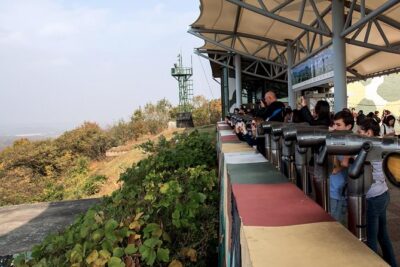
DMZ Tour: 3rd Tunnel, Option(Suspension Bridge, Boat) from Seoul
Read the review →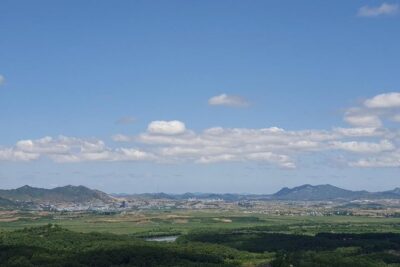
DMZ tour south Korea from Seoul (NK experience hall, defector)
Read the review →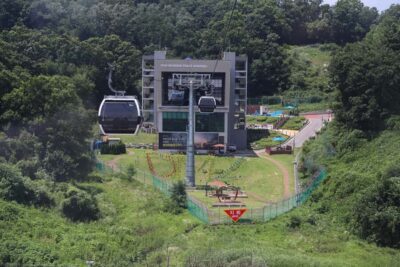
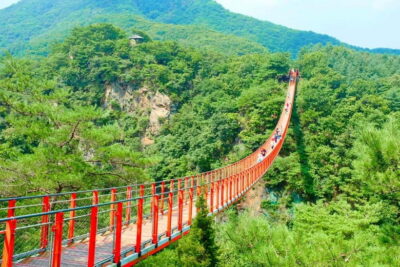
DMZ The 3rd Tunnel and Suspension Bridge Tour
Read the review →
Signature DMZ Tour: Exclusive Defector Talk & Suspension Bridge
Read the review →
Thrilling Korean DMZ 3rd Tunnel Tour from Seoul + Red Bridge Rush
Read the review →
DMZ Past and Present: Korean Demilitarized Zone Tour from Seoul
Read the review →Browse the lists this tour appears in