
Reviewed · DMZ TOURS
[Private] DMZ & Imjingak Peace Gondola Experience Inter-Korean War
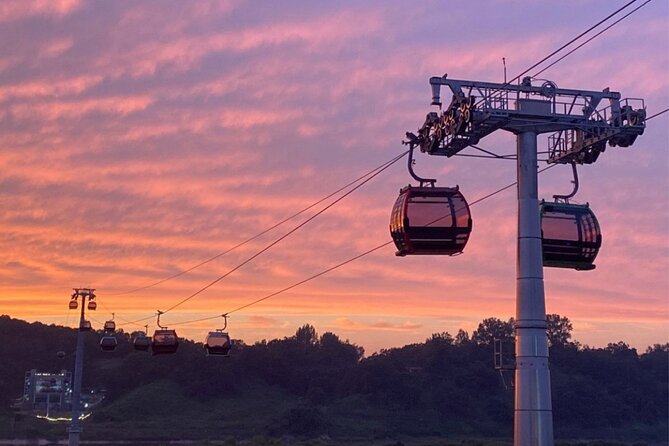
The most striking part of this day is the shift from ordinary Seoul sightseeing to a tightly controlled military zone. You will walk through the Third Infiltration Tunnel, peer toward North Korea from Dora Observatory, and cross above the Imjin River on the Imjingak Peace Gondola.
I like the mix of serious history and unusual transport. The broken Dokgae Bridge gives the division a human scale, while the gondola offers views of Camp Greaves and the surrounding security area. Guides such as JJ and Jackie are praised for clear, patient explanations. The main drawback is that the day can feel crowded and tightly scheduled, with strict photo rules and possible changes if military activity or weather closes the DMZ.
Key points
- The Third Tunnel is physically demanding: The return climb is steep, and you must lean forward in places.
- A passport is required: You cannot join the DMZ portion without a current valid passport.
- Gondola views add a different angle: You can see Camp Greaves, known as a filming location for Descendants of the Sun.
- The schedule depends on military access: Unannounced training or official events can replace the regular route.
- Guides make a major difference: JJ and Jackie are noted for patient, engaging explanations.
- The $195 price covers the main admissions: Transport, an English-speaking guide, DMZ entry, and gondola admission are included.
From Seoul to the Korean DMZ
![[Private] DMZ & Imjingak Peace Gondola Experience Inter-Korean War - From Seoul to the Korean DMZ](https://up.introducingkorea.com/wp-content/uploads/private-dmz-imjingak-peace-gondola-experience-inter-korean-war-1.jpg)
This is an early, full-day outing, usually lasting eight to ten hours. Pickup begins at 7:00 a.m. outside the President Hotel near Euljiro 1-ga subway station, Exit 8, and the day ends in Myeong-dong.
That early start makes sense. The DMZ operates under military rules, and access is not as casual as entry to a palace or museum. You travel in an air-conditioned vehicle, with an English-speaking guide handling the route, timing, and required procedures.
I would arrive early rather than cutting it close. The stated meeting point is the President Hotel at 16 Eulji-ro in Jung District. It is near public transportation, but the tour does not describe hotel pickup, so check your booking details carefully if you are staying elsewhere.
The experience is listed at $195 per person. That is not a bargain-priced day trip, but the cost includes the vehicle, guide, DMZ admission, and Imjingak Gondola admission. You are paying for a long day in a controlled area where access, transport, and timing need to be arranged in advance.
The value depends on your interests. If you want to understand the Korean War and the continuing division of the peninsula, the price covers several important sites in one day. If you mainly want a quick scenic view near the border, this tour may feel expensive and longer than necessary.
More DMZ Tours in Seoul:
- Best DMZ Tour Korea from Seoul (Red Suspension Bridge Optional)
★ 5.0 · 41,422 reviews - DMZ Tour: 3rd Tunnel, Option(Suspension Bridge, Boat) from Seoul
★ 5.0 · 21,373 reviews - DMZ tour south Korea from Seoul (NK experience hall, defector)
★ 5.0 · 20,599 reviews
Imjingak Pavilion and the Meaning of the Border
![[Private] DMZ & Imjingak Peace Gondola Experience Inter-Korean War - Imjingak Pavilion and the Meaning of the Border](https://up.introducingkorea.com/wp-content/uploads/private-dmz-imjingak-peace-gondola-experience-inter-korean-war-2.jpg)
Imjingak Resort is the first major setting for the day. Imjingak Pavilion was built in 1972 and offers broad views over the area. It was designed as a place connected to the pain of division, and the mood is different from a standard sightseeing stop.
You will see security attractions alongside memorial displays and public spaces. The location helps explain why the DMZ is not only a military line but also a place tied to separated families, lost homes, and hopes for future reunification.
The tour also includes a DMZ theater and exhibition hall. This is useful preparation before the more restricted stops. Rather than treating the border as a photo backdrop, the exhibits give you a clearer sense of the conflict and its human cost.
One especially affecting display concerns a letter written by a young man to his mother before his death. Exhibits are available in several languages, including Korean, English, Japanese, and Chinese. That makes the museum portion easier to follow if you do not read Korean.
You should expect crowds at the main tourist facilities. Imjingak is not a quiet, solitary memorial site, and some of the day may feel more like organized sightseeing than private reflection. Still, the exhibits add substance to what could otherwise be a quick stop for photographs.
The Unification Bridge and Military Checkpoint
From Imjingak, the route continues toward the Unification Bridge and the DMZ entry area. This is where the tour becomes more controlled. Identification checks are part of the process, and you must carry your current passport on the day of travel.
You cannot simply wander off or use any vehicle you choose. Every participant must ride the authorized bus and follow the stated photo regulations. Your guide will explain where photographs are allowed, but you need to pay close attention because the rules are part of the visit.
This controlled movement can feel restrictive, especially if you are used to setting your own pace. It is also what makes the area different from an ordinary historical attraction. The access rules reflect the fact that you are visiting an active security zone, not a preserved battlefield.
The itinerary may change at short notice. If there is unannounced military training or an official event, the regular DMZ route can be replaced with Tomorrow’s Whistle, Bunker Beat 131, Odusan Unification Tower, and the War Memorial of Korea. That possibility is important when you book. You should come for the subject and the guide’s explanation, not only for one exact viewpoint.
Walking Through the Third Infiltration Tunnel
The Third Infiltration Tunnel is the most physically demanding stop. It was built for invasion by North Korea and is reached by a steep route. The tunnel requires you to lean forward in places, and the return walk can be tiring.
Wear sneakers. This is not a stop for sandals, dress shoes, or slippery soles. The tour asks for a moderate level of physical fitness, and that warning should be taken seriously. The tunnel is not merely a short underground corridor where you stroll in, take a picture, and leave.
The effort is worthwhile for visitors interested in military history. The narrow passage and steep grade make the engineering and strategic purpose easier to understand than a display case could. You get a physical sense of how such a route might have been used.
Photography rules apply, and you may not be able to take pictures throughout the tunnel. That can disappoint anyone expecting a large collection of dramatic images. I would treat this stop as an educational walk rather than a photo opportunity.
Allow yourself enough energy for the rest of the day. The tunnel comes before the observatory and gondola, so a rushed pace here can make the later stops less enjoyable. Children must be accompanied by an adult, and anyone with mobility concerns should consider the steep conditions before booking.
A few more Seoul half-days to weigh up
- Seoul: DMZ Tour with Optional Suspension Bridge
★ 4.8 · 5,277 reviews - Seoul: DMZ The 3rd Tunnel and Suspension Bridge Tour
★ 5.0 · 4,656 reviews - Signature DMZ Tour: Exclusive Defector Talk & Suspension Bridge
★ 5.0 · 4,459 reviews - Incheon Airport: Traveler SIM & T-money Transportation Card
★ 4.7 · 3,332 reviews
Looking Toward North Korea at Dora Observatory
![[Private] DMZ & Imjingak Peace Gondola Experience Inter-Korean War - Looking Toward North Korea at Dora Observatory](https://up.introducingkorea.com/wp-content/uploads/private-dmz-imjingak-peace-gondola-experience-inter-korean-war-4.jpg)
Dora Observatory gives you a chance to look toward North Korea. On a clear day, the view is the point of the stop, but visibility is not guaranteed. Fog can reduce the experience to a general sense of proximity rather than a clear panorama.
That uncertainty is part of the DMZ. You are not visiting a viewing platform designed only for scenery. Military restrictions, weather, and distance all shape what you can see. The observatory is most valuable when your guide explains what lies beyond the viewpoint and why the area matters.
Keep expectations practical. You may not see a dramatic, close-up picture of North Korea. The experience is more about standing at a monitored border and understanding how near the two countries are, despite the political distance between them.
This is also one of the places where strict photo timing matters. The tour notes that all participants must follow the photo regulations and the authorized schedule. You will get instructions from the guide, but you should not assume you can remain at the viewing area as long as you like.
Dorasan Station, a Railway Waiting for Reunification
![[Private] DMZ & Imjingak Peace Gondola Experience Inter-Korean War - Dorasan Station, a Railway Waiting for Reunification](https://up.introducingkorea.com/wp-content/uploads/private-dmz-imjingak-peace-gondola-experience-inter-korean-war-5.jpg)
Dorasan Station represents a different idea of the border. It is linked to the hope of reconnecting North and South Korea by rail. The station is therefore less about military hardware and more about the possibility of future movement across a currently closed division.
I like this contrast. The Third Tunnel shows preparation for conflict, while Dorasan Station points toward cooperation. Together, the two stops keep the day from becoming a simple military tour.
The station is also a reminder that the division affects transport, families, and everyday life. You are looking at a working symbol of a connection that has not yet been restored. The guide’s explanation matters here, since the physical station alone may not tell you why it has such importance.
Lunch follows the main morning sights. The supplied details do not specify the restaurant, menu, or whether a meal is included in the price, so plan for personal expenses. The tour specifically lists personal expenses as not included.
Dokgae Bridge and Bunker Beat 131
![[Private] DMZ & Imjingak Peace Gondola Experience Inter-Korean War - Dokgae Bridge and Bunker Beat 131](https://up.introducingkorea.com/wp-content/uploads/private-dmz-imjingak-peace-gondola-experience-inter-korean-war-6.jpg)
After lunch, the itinerary returns to Imjingak Resort for Dokgae Bridge. This was a northbound railroad bridge on the Gyeongui Line over the Imjin River. It has remained broken for nearly 70 years, a simple but powerful reminder of how the war interrupted ordinary connections.
A damaged railway bridge can say more than a large monument. Railways usually carry workers, families, goods, and news. Here, the broken span turns that everyday purpose into a visible sign of separation.
Bunker Beat 131 adds another security-focused stop. The bunker is part of the alternative route that may be used if military conditions prevent access to the regular DMZ itinerary, and it is also connected with the Imjingak area in the scheduled program.
These stops help widen the day beyond the most famous attractions. You are not only looking across the border. You are seeing the systems, bridges, bunkers, museums, and stations shaped by the conflict.
The Imjingak Peace Gondola and Camp Greaves
![[Private] DMZ & Imjingak Peace Gondola Experience Inter-Korean War - The Imjingak Peace Gondola and Camp Greaves](https://up.introducingkorea.com/wp-content/uploads/private-dmz-imjingak-peace-gondola-experience-inter-korean-war-7.jpg)
The gondola is the most unusual part of this experience. You ride above the area near Imjingak and can see Camp Greaves, a former military site known as a filming location for Descendants of the Sun.
The ride gives you a different view after the enclosed tunnel and regulated observatory. From above, you can take in the river area and the relationship between the resort, military sites, and border zone. It also adds variety to a day that otherwise relies heavily on buses, indoor exhibits, and walking.
The gondola is not a replacement for the DMZ itself. It does not remove the need to understand the history or follow the security rules. Instead, it gives you a more visual way to connect the places you have visited.
The experience also has a popular-culture link through Camp Greaves. Fans of the drama may recognize the setting, while other visitors may simply appreciate seeing a former military location from the air. The tour information also connects Camp Greaves with the 506th Regiment and references to American wartime stories such as Band of Brothers and Saving Private Ryan.
The gondola portion lasts about an hour. That makes it a meaningful part of the afternoon rather than a quick ride added at the last minute.
What the Guides Add to the Day
![[Private] DMZ & Imjingak Peace Gondola Experience Inter-Korean War - What the Guides Add to the Day](https://up.introducingkorea.com/wp-content/uploads/private-dmz-imjingak-peace-gondola-experience-inter-korean-war-8.jpg)
A DMZ tour rises or falls on the guide. The sites have real weight, but the meaning is not always obvious when you are looking at a bunker, bridge, or distant hillside.
JJ receives especially warm praise for being engaging and for creating an opportunity to hear from a North Korean defector about her journey to freedom. That kind of personal account can change the tone of the day, moving the subject from military history to lived experience.
Jackie is noted for patience, helpfulness, and clear explanations. Those qualities matter here because the schedule is controlled, the rules can be confusing, and the group may need repeated reminders about meeting times and photographs.
The experience can accommodate up to 99 people, so do not assume the word private means a quiet, one-on-one outing at every stop. The vehicle and guide arrangements may be private at some stages, but access inside the DMZ requires authorized transport and shared procedures. Confirm the exact group setup before booking if that distinction matters to you.
Practical Advice Before You Book
Bring your passport, not a photocopy. It is required for every participant on the day of travel. Wear sturdy sneakers, especially for the Third Tunnel.
You should also prepare for a long day. The itinerary begins at 7:00 a.m., includes several stops, a steep tunnel walk, lunch, and a gondola ride, and returns to central Seoul in Myeong-dong.
Keep your schedule flexible. The DMZ can close because of poor weather, military training, or an official event. If the regular route is canceled, the replacement may include Tomorrow’s Whistle, Bunker Beat 131, Odusan Unification Tower, and the War Memorial of Korea.
Free cancellation is available up to 24 hours before the start time. Cancellations made less than 24 hours before departure are not refunded, and changes inside that window are not accepted. If poor weather causes the operator to cancel, you are offered another date or a full refund.
The tour suits adults, older children who can manage the tunnel, history-minded visitors, and anyone who wants more context than a quick border photo. It is less suitable if you dislike early starts, fixed schedules, large groups, military restrictions, or physically demanding walks.
Should You Book This DMZ and Gondola Tour?
I would book this experience if you want a full account of the border area rather than one viewpoint. The combination of Imjingak Pavilion, the Third Tunnel, Dora Observatory, Dorasan Station, Dokgae Bridge, Bunker Beat 131, and the gondola gives you several ways to understand the division.
The best reason to choose it is the guide. JJ or Jackie can make the difference between a series of stops and a connected story about war, separation, security, and reunification.
I would hesitate only if you need a guaranteed itinerary or a quiet private day. The DMZ can change without warning, photos are restricted, crowds may be present, and the $195 cost is significant. For a first visit to the Korean border, though, the transport, admissions, guide, and range of sites make it a sensible use of a long day from Seoul.
FAQ
Where does the tour start?
The tour starts at 7:00 a.m. at the President Hotel, 16 Eulji-ro, Jung District, Seoul. The meeting point is near Euljiro 1-ga subway station Exit 8.
Where does the tour end?
The tour ends in Myeong-dong, in Seoul’s Jung District.
How long does the experience last?
The full experience lasts approximately eight to ten hours.
Is an English-speaking guide included?
Yes. An English-speaking tour guide is included. Guides associated with the experience include JJ and Jackie.
Is the gondola admission included?
Yes. Admission to the DMZ and the Imjingak Peace Gondola is included.
Do I need to bring my passport?
Yes. Every participant must bring a current valid passport on the day of travel.
Is the Third Infiltration Tunnel difficult?
Yes. The tunnel route is quite steep, requires you to lean forward in places, and calls for good physical fitness. Sneakers are required for safety.
Can the itinerary change?
Yes. Unannounced military training or an official event can cause the regular DMZ route to be replaced with Tomorrow’s Whistle, Bunker Beat 131, Odusan Unification Tower, and the War Memorial of Korea.
What happens if bad weather cancels the tour?
If poor weather causes cancellation, you will be offered another date or a full refund. You can also cancel for a full refund if you do so at least 24 hours before the scheduled start time.
Recently added around Seoul
- Nami & Maple Road & Theatre des Lumieres Day Tour from Seoul★ 4.8 · 4 reviews
- Gyeongbokgung Palace Photo Session with your own phone★ 5.0 · 4 reviews
- Private Tour around Suwon UNESCO Fortress and Korea Folks Village★ 4.5 · 4 reviews
- N Seoul Tower + Namsan Cable Car Ticket (Collect in Myeongdong)★ 3.5 · 4 reviews
- Jisan Forest Resort: Ski Full-Day Tour or Shuttle from Seoul★ 5.0 · 4 reviews
- Seoul: Deoksugung Palace Night Tour★ 4.5 · 4 reviews
- Seoul Private Walking Tour with a Local★ 5.0 · 4 reviews
- Private Jeonju Hanok Village – Culinary tour★ 5.0 · 4 reviews
DMZ Tours, compared.
Best DMZ Tour Korea from Seoul (Red Suspension Bridge Optional)
Read the review →
DMZ Tour: 3rd Tunnel, Option(Suspension Bridge, Boat) from Seoul
Read the review →
DMZ tour south Korea from Seoul (NK experience hall, defector)
Read the review →
DMZ Insider Tour: 3rd Tunnel, NK Defector Meet & Red Bridge
Read the review →
DMZ The 3rd Tunnel and Suspension Bridge Tour
Read the review →
Signature DMZ Tour: Exclusive Defector Talk & Suspension Bridge
Read the review →
Thrilling Korean DMZ 3rd Tunnel Tour from Seoul + Red Bridge Rush
Read the review →Browse the lists this tour appears in