
Reviewed · SEOUL TOURS
Gyeongju UNESCO Sites Tour by KTX train; The Museum Without walls
Gyeongju is Korea’s open-air history book, and this tour gives you a lot of it in one carefully planned day. You’ll see royal burial mounds, a seventh-century palace pond, Korea’s best-known Buddhist temple, and the hilltop Seokguram Grotto, all after a fast KTX ride from Seoul. I especially like the private format and the way the tour links major Silla sites instead of leaving you to piece them together by local bus.
I also like that the price includes round-trip KTX tickets, site admissions, a private vehicle, and an English-speaking guide. That removes much of the day’s friction. The catch is distance: this is an eight-to-nine-hour excursion with a 7:00 am start, and one traveler found the long ride from Seoul too much for a day trip, especially in heavy rain.
Key points to know before booking
- KTX makes Gyeongju possible in a single day: The high-speed train cuts the long Seoul to Gyeongju journey to roughly two hours each way.
- Six major stops cover the Silla story: You move from royal tombs and an ancient observatory to a museum, palace grounds, temple, and Buddhist grotto.
- The tour is private: Only your own group takes part, with a private car for transfers in Gyeongju.
- Guides vary by departure: Guides named in the feedback include Jay, Andrew, John, and Dylan, so you should not assume a particular person will lead your tour.
- Lunch is not included: You’ll need to pay for meals, though one guide took a group to a local restaurant.
- The day ends without Seoul hotel drop-off: Pickup is offered in Seoul areas, but return hotel service is not included.
Why Gyeongju makes a worthwhile break from Seoul
Seoul is Korea’s modern center, but Gyeongju tells an older story. For nearly a thousand years, it was the capital of the Silla kingdom, and its royal tombs, temples, sculptures, and court sites are spread across the city rather than confined to one museum complex.
That is why the nickname museum without walls fits. You are not simply moving from one indoor display to another. You are walking among grassy burial mounds, looking across an old palace pond, examining stone pagodas, and climbing toward a Buddhist sanctuary in the mountains.
The practical problem is getting there. Gyeongju is far enough from Seoul that independent visitors need to plan train tickets, local transportation, admission fees, and a route that makes geographic sense. This tour handles those pieces for you. A private car also matters because the stops are spread out, with Bulguksa and Seokguram away from the central historical area.
At $470 per person, this is not a budget day trip. The value comes from convenience and privacy rather than low cost. Your fee covers economic-class KTX tickets, entrance fees, a local English-speaking guide, Seoul pickup, and private vehicle transfers. Meals are extra, and you arrange your own way back to your Seoul hotel after the tour.
More Museums in Seoul
- Seoul: War Memorial of Korea Private Guided Museum Tour
★ 4.9 · 29 reviews - DMZ Tour + The War Memorial of Korea Museum
★ 5.0 · 28 reviews - Color Pool Museum
★ 4.0 · 22 reviews
Starting at 7:00 am with the KTX
The day begins early. Pickup is offered from Seoul-area hotels, and the transport arrangements are designed to get you onto the KTX without having to sort out the station on your own.
This careful handoff has been one of the strongest parts of the experience. Andrew, for example, picked up a group from an Airbnb, drove them to the station, waited with them, and walked them to the train. Another group was met by a staff member who escorted them through the subway station and helped them reach their seats.
Those details may sound small, but they are useful at 7:00 am in an unfamiliar city. You are not left wondering which platform to use or how to handle reserved seats. The train ride takes about two hours, giving you a chance to rest before the sightseeing begins.
The return trip is included, but remember that the tour does not provide hotel drop-off in Seoul. You will need to make your own way from the arrival station to your accommodation. Ask in advance exactly where the Seoul pickup and KTX arrangements will meet your group.
Cheonmachong Tomb and the royal burial grounds
Your first major stop is Cheonmachong Tomb, in an area containing more than 20 large and small Silla-period tombs. These rounded earthen mounds are believed to belong to kings and court officials, and their simple shapes can look almost like natural hills at first glance.
The value of this stop comes from scale. You begin to understand that Silla’s capital was not just a place of palaces and temples. The city was also a royal cemetery, with huge mounds marking the power and ceremony of the kingdom.
Admission is included, and about an hour is planned here. One particularly useful feature is the chance to walk inside an excavated tomb. That gives you a closer look at how the mound was constructed and makes the burial customs easier to grasp than a quick view from the outside.
Your guide can also connect the tombs to the objects now held in the museum later in the day. That link matters. Without explanation, the mounds may seem repetitive. With context, they become part of a larger story about kingship, burial, craftsmanship, and Silla court life.
Gyeongju National Museum puts the pieces together
The Gyeongju National Museum is arguably the strongest history museum in Korea, and this is where the morning’s outdoor sights begin to make sense. The main archaeological displays contain ceremonial objects and relics from the Silla dynasty, including the kinds of treasures associated with the tombs you have just seen.
You get about an hour inside. That is enough for a focused visit, though not enough to inspect every display at a slow pace. Stay close to your guide and ask which objects best explain Silla power and belief. The museum is much more rewarding when you understand why a particular crown, ornament, bell, or burial item matters.
This stop also provides a welcome break from walking outdoors. If the weather is poor, it may become one of the day’s most comfortable stops. Still, the schedule is tight, so you should not expect the unhurried museum time you would have on a dedicated Gyeongju museum visit.
More rail trips from Seoul:
- Busan: Coastal Treasures Beach Train, Culture Village & More
★ 4.7 · 832 reviews - Busan’s Cultural Wonders with Beach Train & Gamcheon Village etc
★ 4.5 · 663 reviews - Busan city tour from Seoul by KTX bullet train
★ 5.0 · 39 reviews
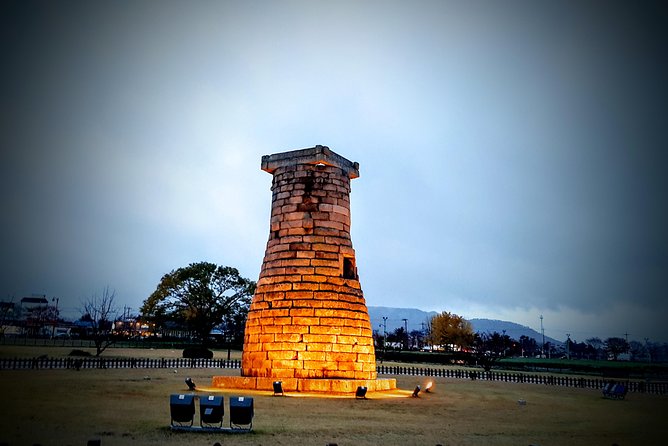
Cheomseongdae, the star-gazing tower
Cheomseongdae means star-gazing tower. Built in 634 during the reign of Queen Seondeok, it is described as the oldest surviving observatory in the Far East.
The stone tower is compact, distinctive, and easy to see in an hour. Its 27 levels of stone are tied to the structure’s symbolic meaning, and your guide can explain how the tower fits into Silla science and royal culture.
This is an outdoor stop, so rain and heat can affect how much you enjoy it. You will not spend a long time inside or under cover. I would treat Cheomseongdae as a short but important pause between the larger museum and palace visits, not as a stand-alone attraction that fills an hour by itself.
Its real value is the setting. The tower helps you picture Silla as a functioning capital with astronomy, ritual, court politics, and engineering, not simply as a collection of old monuments.
Donggung Palace and Wolji Pond after dark in spirit
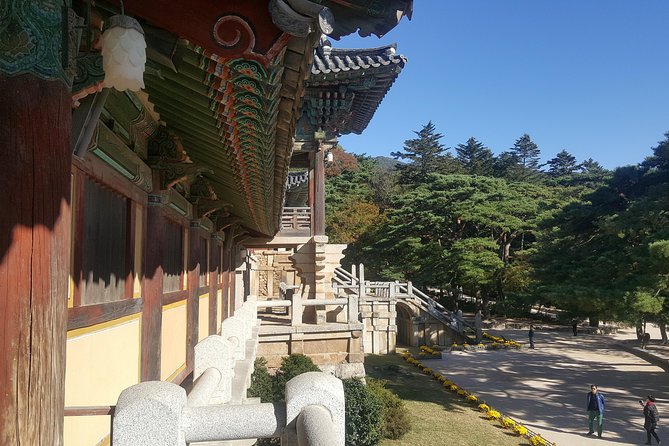
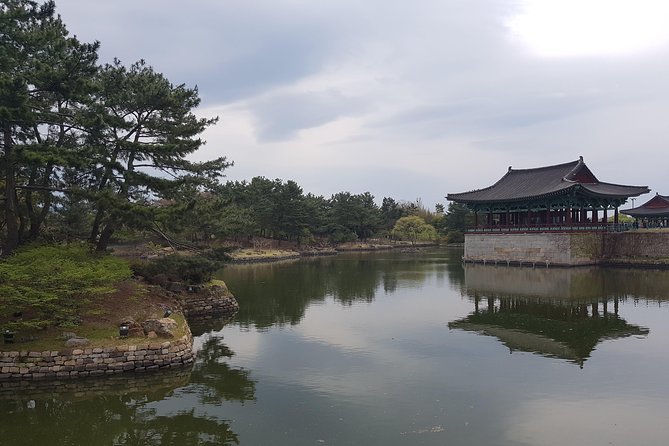
Donggung Palace and Wolji Pond, formerly known as Anapji Pond, was created in 674 after the unification of the Korean Peninsula. The court grounds included artificial hills, trees, flowers, birds, and animals, making this a carefully designed royal retreat rather than a plain pool.
You have roughly an hour here, with admission included. The pond is one of Gyeongju’s most pleasing places to pause because water and reconstructed palace features give the site a different feel from the tombs and museum.
The name change is worth noting. Many older guidebooks and signs use Anapji Pond, while Donggung Palace and Wolji Pond is the current name most often used. If you see both names, you are looking at the same historic site.
Like Cheomseongdae, this stop is outdoors. Rain can make the paths less pleasant, and poor weather may reduce the views across the pond. One person described heavy rain as a major problem because so much of the day takes place outside. Check the forecast and bring suitable shoes and rain protection.
Bulguksa Temple and the Silla stone pagodas
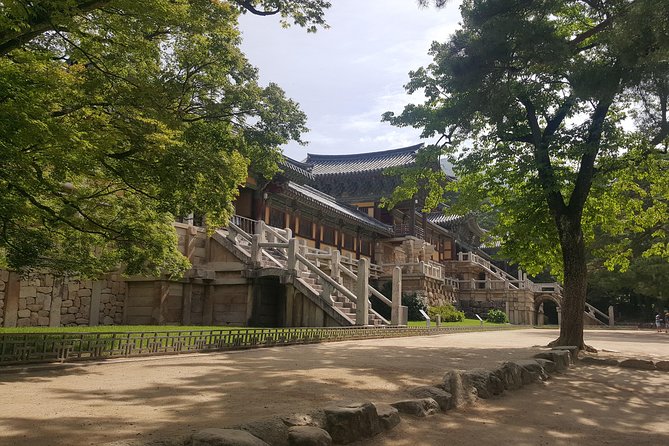
Bulguksa is Korea’s best-known Buddhist temple and one of the central stops of the day. It contains important Silla-period relics, most famously the Dabotap and Seokgatap stone pagodas.
The temple is not just a pretty collection of buildings. Its stairways, courtyards, pagodas, and stone details express Buddhist ideas through architecture. Your guide can point out the features that are easy to miss if you visit alone, especially the difference between the two famous pagodas and the meaning attached to the temple layout.
An hour gives you a useful introduction, but it will feel short if you want to photograph every courtyard or examine every carving. The temple grounds also require walking, and some portions may be affected by weather or crowd levels.
Bulguksa is paired with Seokguram, which makes sense historically and geographically. The two sites form a single major Buddhist center connected with Silla’s religious art and royal patronage.
Seokguram Grotto and the mountain view
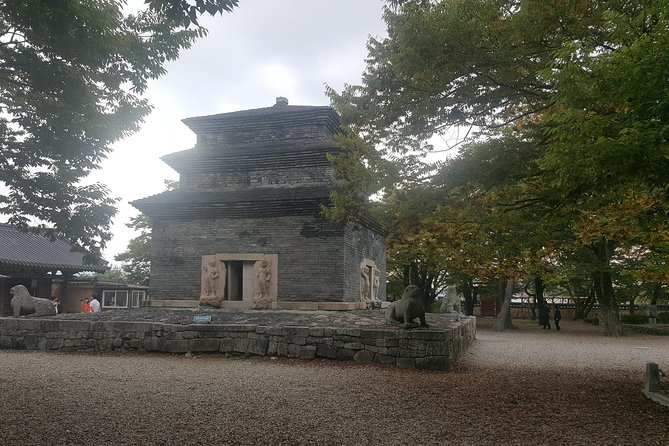
Seokguram Grotto is a hermitage associated with Bulguksa. It sits about 750 meters above sea level and overlooks the East Sea, giving the final part of the tour a very different setting from central Gyeongju.
The grotto holds highly regarded Buddhist sculptures, centered on a large Buddha image. The site’s power comes from the combination of sculpture, stone chamber, mountain position, and sea-facing view. Even if you have seen many Korean temples, Seokguram offers something distinct.
The route is not simply another urban monument. You are going uphill and moving into a more remote setting, so the hour allotted here includes the approach as well as time at the grotto. Wear shoes suitable for walking and allow your guide to manage the timing.
Photography rules and viewing arrangements may limit how long you can study the sculpture directly, but the visit remains an important part of the Silla story. Bulguksa shows religious architecture in a temple complex. Seokguram shows Buddhist sculpture in a carefully chosen mountain sanctuary.
What the private format changes
This is a private tour, meaning only your group participates. That gives you more control than a large coach excursion. You can ask questions, tell the guide when you need a short pause, and avoid spending the day waiting for a bus full of strangers.
It also makes the transportation easier. A private car connects the central tombs, museum, observatory, palace pond, temple, and mountain grotto. You are not trying to match several public buses to a demanding schedule.
The guides named in the feedback include Jay, Andrew, John, and Dylan. Their styles may differ, but the useful pattern is clear: the best part of the tour depends heavily on the person assigned to your group. Jay was praised for taking a group through the historic areas, John for explaining Silla stories and choosing a local restaurant, and Dylan for being personable while guiding a full day of sightseeing.
English delivery can vary. One person found the guide’s accent difficult even though his command of Korean history and culture was strong. If precise spoken English is especially important to you, send the operator a question before booking and ask about the guide assigned to your date.
Meals, pacing, weather, and the real cost
Meals are not included, so you should budget extra for lunch. A guide took one group to a small local restaurant, where the portions were large and the food was well received. The exact restaurant is not guaranteed, but the stop shows why a private guide can be useful when you need to eat without losing too much time.
The pace is brisk. Six stops at about an hour each, plus train travel, transfers, meals, and station connections, fill the day quickly. You will see more than on a casual independent visit, but you will not have long stretches for sitting, shopping, or wandering without a schedule.
At $470 per person, the tour makes the most sense for people who value time and simplicity. A private car, guide, admissions, and KTX tickets would be difficult to coordinate neatly in one day. The price is harder to justify if you are comfortable arranging trains and local transport yourself, or if you want to spend two or three days in Gyeongju.
The 4.6 rating from 11 reviews and 91 percent recommendation suggest a strong experience overall, while the lower rating points to the main risks: a long day, outdoor sightseeing in bad weather, and possible differences in spoken English.
Who should book this Gyeongju day trip?
I would choose this tour if you have limited time in Korea and want one concentrated day focused on ancient Silla culture. It suits couples, families, and small groups who prefer a private guide and do not want to navigate Gyeongju’s spread-out sites on their own.
It is also a good fit if you care more about seeing the major sites than lingering at one of them. The route gives you burial mounds, museum displays, astronomy, palace gardens, Buddhist architecture, and sculpture in one sweep.
I would hesitate if you dislike early starts, long train days, or fixed schedules. I would also think twice if your visit falls during heavy rain, since Cheomseongdae, Donggung Palace, Bulguksa, and the approach to Seokguram all involve outdoor time.
Book this tour when convenience is worth the premium and Gyeongju is a priority but you cannot spend a night there. Skip it when you have several days in Korea and would rather explore Gyeongju slowly, or when the price leaves too little room in your travel budget.
FAQ
How long does the tour last?
The tour lasts approximately eight to nine hours, including the journey from Seoul and the sightseeing in Gyeongju.
What time does the tour start?
The scheduled start time is 7:00 am.
Is transportation from Seoul included?
Yes. The experience includes round-trip economic-class KTX fare, Seoul-area hotel pickup, and round-trip transfer service with a private vehicle.
Is Seoul hotel drop-off included?
No. Hotel pickup is offered, but hotel drop-off in Seoul is not included.
Which Gyeongju sites are visited?
The stops are Cheonmachong Tomb, Gyeongju National Museum, Cheomseongdae Observatory, Donggung Palace and Wolji Pond, Bulguksa Temple, and Seokguram.
Are entrance fees included?
Yes. Admission fees to the tourist sites listed in the tour are included.
Is lunch included?
No. Meals are not included in the price.
Can I cancel for a full refund?
Yes, if you cancel at least 24 hours before the experience start time. Cancellations made less than 24 hours in advance are not refunded, and the experience may be canceled with a full refund if its minimum number of participants is not met.
Recently added around Seoul
- Nami & Maple Road & Theatre des Lumieres Day Tour from Seoul★ 4.8 · 4 reviews
- Gyeongbokgung Palace Photo Session with your own phone★ 5.0 · 4 reviews
- Private Tour around Suwon UNESCO Fortress and Korea Folks Village★ 4.5 · 4 reviews
- Jisan Forest Resort: Ski Full-Day Tour or Shuttle from Seoul★ 5.0 · 4 reviews
- N Seoul Tower + Namsan Cable Car Ticket (Collect in Myeongdong)★ 3.5 · 4 reviews
- Seoul: Deoksugung Palace Night Tour★ 4.5 · 4 reviews
- Seoul Private Walking Tour with a Local★ 5.0 · 4 reviews
- Private Jeonju Hanok Village – Culinary tour★ 5.0 · 4 reviews
Seoul Tours, compared.
Best DMZ Tour Korea from Seoul (Red Suspension Bridge Optional)
Read the review →
DMZ Tour: 3rd Tunnel, Option(Suspension Bridge, Boat) from Seoul
Read the review →
DMZ tour south Korea from Seoul (NK experience hall, defector)
Read the review →
DMZ The 3rd Tunnel and Suspension Bridge Tour
Read the review →
Signature DMZ Tour: Exclusive Defector Talk & Suspension Bridge
Read the review →
Thrilling Korean DMZ 3rd Tunnel Tour from Seoul + Red Bridge Rush
Read the review →
DMZ Past and Present: Korean Demilitarized Zone Tour from Seoul
Read the review →Browse the lists this tour appears in